Key results
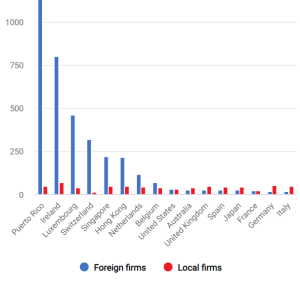
- Multinational enterprises use sales platforms to report foreign sales in tax havens without necessarily exporting goods and services from there. As a result, the foreign sales ratio is much higher in tax havens than in non-havens.
- 66 $bn to 85 $bn of profits were shifted to tax havens using sales shifting in 2013.
- Sales shifting explains 88%, 72% or 71% of the profits reported by US multinational companies’ affiliates respectively in Bermuda, Ireland or Luxembourg.
Policy implications
Proposals to redistribute international taxing rights according to sales should formulate precisely what type of sales they target as multinational enterprises manipulate the location of sales. The lack of data on the destination of sales (where the final user or consumer of the good or service is located) makes it difficult to simulate the revenue implications of destination-based corporate tax rules.
Data
Laffitte and Toubal use the statistics of the Bureau of Economic Analysis (BEA) on the activities of US multinational enterprises. They focus on the activities of their majority-owned foreign affiliates in 56 countries and 11 industries from 1999 to 2013.
Methodology
The authors compute average foreign sales ratios, ratios of sales to exports or ratios of sales to employment and analyse their heterogeneity across sectors and host countries. The “foreign sales ratio”, is the ratio of foreign sales to the total sales reported in the host country. For example, in 2018, the Italy-based affiliates of US multinational companies in chemical industries registered 14.5 $bn of sales, 9.4 $bn of which were directed to the host country, 0.8 $bn to the US and 4.3 $bn to other countries: this corresponds to a foreign sales ratio of (4.3 + 0.8) / 14.5 = 35%.
For their econometric analysis, the authors use fractional logit regressions and traditional linear regressions with different specifications to identify the causal effect of the host country’s tax environment on the foreign sales ratio.
To quantify the scale of profit shifting and compare it to other profit shifting estimates in the literature, they regress firms’ profits on the interaction of the tax haven status of the host country and its foreign sales ratio, as well as a number of control variables. Setting the corresponding coefficient to 0, they can predict the amount of profits observed in the absence of sales shifting to tax havens and approximate the scale of the phenomenon.
Go to the original article
This article was published in the
American Economic Journal: Economic Policy 14(4) in 2022.
Go to
the journal's website
An older working paper version can be downloaded from
RePEc Ideas.