Avoiding taxes: banks’ use of internal debt
Research by Reiter, Langenmayr & Holtmann 2021
Summary
Reiter, Langenmayr, and Holtmann investigate how German multinational banks shift profits to low-taxed affiliates by using internal debt. They use the External Position of Banks database of the Deutsche Bundesbank (2015), an administrative dataset on assets and liabilities in foreign affiliates of German multinational banks and the respective German headquarters.
As interest payments are usually tax-deductible, multinational enterprises can set up financing structures that inflate the interest payments that affiliates in high-tax countries pay to affiliates in low-tax countries, thereby reducing corporate income tax payments. While previous literature has mostly documented the strategic use of external and internal debt by non-financial firms, the authors aim at filling a gap by focusing on internal debt in the financial sector.
Using panel regressions, they find that banks use internal debt to shift profits to low tax countries, and they do so more aggressively than non-financial firms. A higher statutory corporate tax rate in a given country has a significant effect on the level of internal debt of banks in this country, which can be interpreted as evidence of tax-motivated debt-shifting.
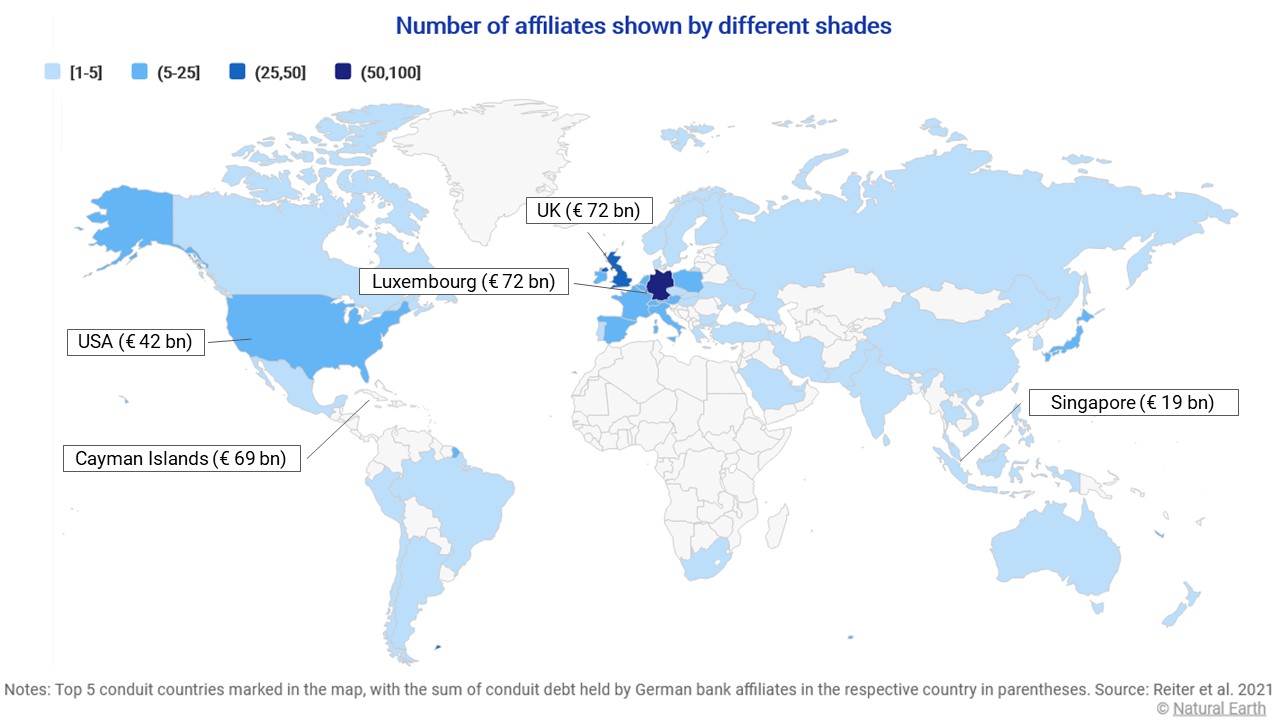
In addition, this paper sheds light on the role of conduit entities which pass through internal loans without shifting profits away from themselves. Conduit entities can serve as investment hubs in the corporate group structure but may also be used to conceal profit shifting structures or generate additional tax savings by transfer-mispricing. The authors point out that previous research on debt-shifting does not account for the double-counting of debt passed through conduit entities. As most conduit affiliates are located in low-tax countries, the previous literature has probably underestimated the extent of debt shifting. This is because the relationship between the debt level and the tax rate cannot be estimated accurately in the presence of double-counting of debt. The authors thus propose a new dependent variable, the internal net-debt-to-assets ratio, which reveals an even more intensive use of debt-shifting by German multinational banks.
Key results
- Banks use internal debt to shift profits to low tax countries more aggressively than non-financial firms.
- A ten percentage points higher corporate tax rate increases the internal net debt ratio by 5.7 percentage points.
- Conduit affiliates of multinational banks tend to be located in tax havens and low tax countries. Previous estimates of internal debt-shifting are likely biased downwards as they fail to account for the double-counting of debt in these conduit affiliates.
- The authors identify a need for specific anti-tax avoidance rules in the financial sector, such as limiting the deductibility of internal interest payments because the main current anti-tax avoidance rules, controlled-foreign corporation (CFC) and thin capitalization rules, either do not apply to or are not effective in the financial sector.